> ## Documentation Index
> Fetch the complete documentation index at: https://docs.alpacaml.com/llms.txt
> Use this file to discover all available pages before exploring further.
# Transfer
> Explore infinite variations of your projects
Transfer allows you to modify existing images using a text prompt as a control.
This is useful for exploring possible variations of an scene, assert or character,
or rendering low-fidelity color-blocked images into stylized and shaded ones.
Your Alpaca plugin may look a bit different than in the video as we are
constantly improving it.
Transfer is controlled by two inputs:{" "}
* a reference image
* a text prompt.
The base reference image will specify the general form and the underlying color palette, though depending on the `Transfer Strength` parameter, Alpaca will be more or less liberal
in altering the form.
The text prompt can be used to alter the art style, silhouette, and shading/lighting of the reference image. Typically, Transfer stays
close to the original color palette.
You can find some example reference images and prompts like the ones used in this example below.
```txt Prompt theme={null}
treasure chest, cyberpunk, sci-fi, futuristic, technology, post-apocalyptic, masterpiece, best quality, epic, cinematic lighting
```
## Reference Image
You can also guide **Imagine** by leveraging existing images as a template, also known as a "reference" image.
We currently support 4 types of references:
* **Pose**: Extracts the specific pose of a character from the reference image to generate new images of characters in identical poses.
* **Depth**: Preserves the spatial arrangement or 'composition' of the reference image in the newly generated images.
* **Hard Edges**: Matches the sharp boundaries, lines or 'edges' found in the reference image in the generated images.
* **Soft Edges**: Similar to **Hard Edges** but with a bit more freedom allowed.
Check our guide [Using References to Guide Composition](/classic/references) to learn how to use references with Alpaca.
## Parameters
***
### Prompt
The `Prompt` box, located in the main section of the Alpaca panel, takes in a text prompt describing the subject matter,
style, composition, and characteristics of your desired image. You can also describe what you do not want to see in the output by clickling on `Exclude`.
You can learn more about writing prompts by checking our our [Prompt Guide](/guides/prompting).
### Images
Allows you to specify how many images you want Alpaca to generate from 1 to 5. The higher the number of images, the more credits the generation will cost, and the slowest it will be.
### Seed
The seed acts as a unique identifier, guiding the creation process of each generation.
If you retain the same seed with identical settings, the output will always be the same.
Retain the seed, while changing other parameters (e.g. altering the prompt) and you'll derive a distinct yet related creation.
For an element of unpredictability, set the seed to `0` and Alpaca will choose a random seed for each image, creating more variations
### Steps
Higher number of steps will lead to better quality, but also cost more credits and make the generation slower.
### Prompt Strength
The `Prompt Strength` slider controls the influence of the prompt — higher values of this parameter force the model to be more
attentive to the prompt. We can consider this to be a “rigid” vs “relaxed” interpretation of the prompt. 7 is a good balance.
### Transfer Strength
The `Transfer Strength` slider is found in the Advanced settings tab. It controls the degree to which changes are made to the input image. A low `Transfer Strength` will
keep the output close to the original input image, while a high value will add more shading, lighting, detail, and compositional variation to the output.
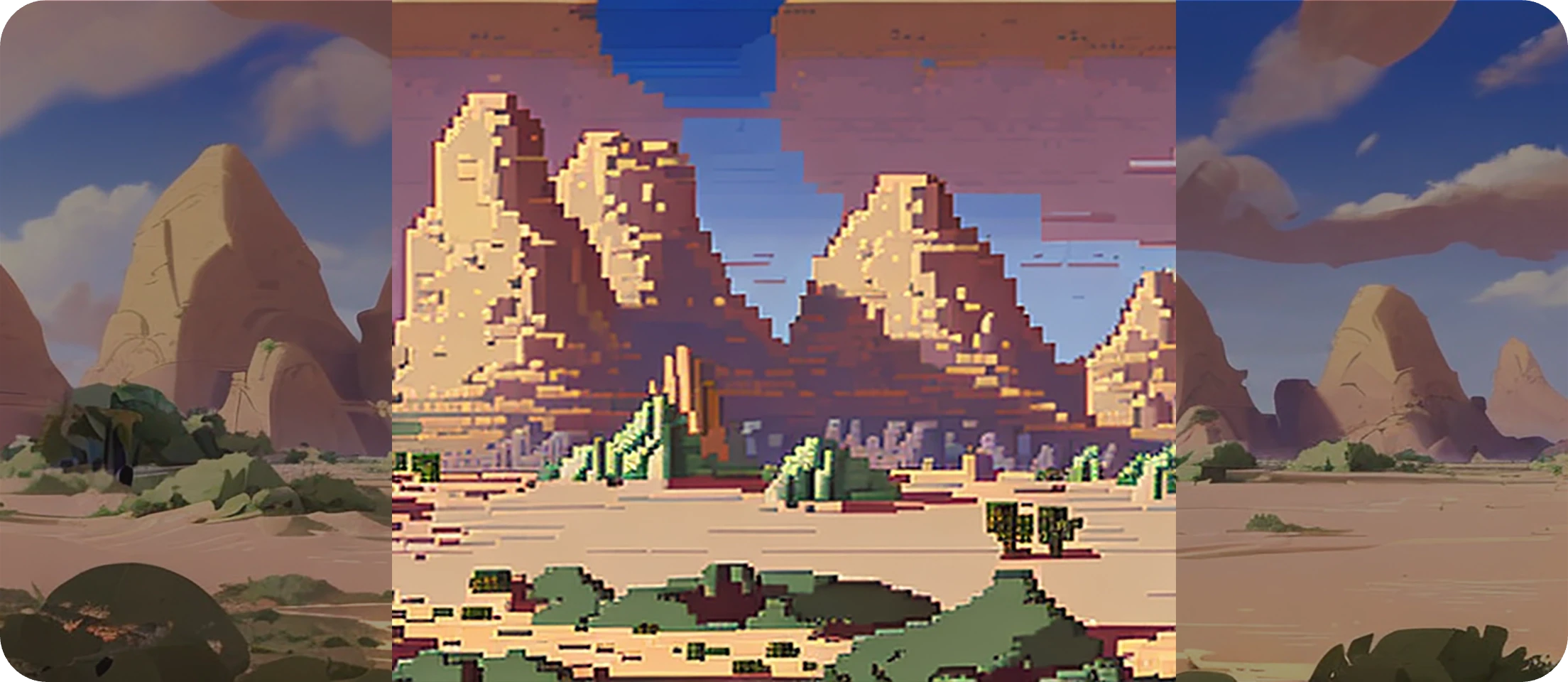 Transfer allows you to modify existing images using a text prompt as a control.
This is useful for exploring possible variations of an scene, assert or character,
or rendering low-fidelity color-blocked images into stylized and shaded ones.
Transfer allows you to modify existing images using a text prompt as a control.
This is useful for exploring possible variations of an scene, assert or character,
or rendering low-fidelity color-blocked images into stylized and shaded ones.
 ```txt Prompt theme={null}
treasure chest, cyberpunk, sci-fi, futuristic, technology, post-apocalyptic, masterpiece, best quality, epic, cinematic lighting
```
## Reference Image
You can also guide **Imagine** by leveraging existing images as a template, also known as a "reference" image.
We currently support 4 types of references:
* **Pose**: Extracts the specific pose of a character from the reference image to generate new images of characters in identical poses.
* **Depth**: Preserves the spatial arrangement or 'composition' of the reference image in the newly generated images.
* **Hard Edges**: Matches the sharp boundaries, lines or 'edges' found in the reference image in the generated images.
* **Soft Edges**: Similar to **Hard Edges** but with a bit more freedom allowed.
Check our guide [Using References to Guide Composition](/classic/references) to learn how to use references with Alpaca.
## Parameters
***
```txt Prompt theme={null}
treasure chest, cyberpunk, sci-fi, futuristic, technology, post-apocalyptic, masterpiece, best quality, epic, cinematic lighting
```
## Reference Image
You can also guide **Imagine** by leveraging existing images as a template, also known as a "reference" image.
We currently support 4 types of references:
* **Pose**: Extracts the specific pose of a character from the reference image to generate new images of characters in identical poses.
* **Depth**: Preserves the spatial arrangement or 'composition' of the reference image in the newly generated images.
* **Hard Edges**: Matches the sharp boundaries, lines or 'edges' found in the reference image in the generated images.
* **Soft Edges**: Similar to **Hard Edges** but with a bit more freedom allowed.
Check our guide [Using References to Guide Composition](/classic/references) to learn how to use references with Alpaca.
## Parameters
***